How Bitcoin Cloud Mining Works
Learn how Bitcoin cloud mining works, what a mining contract covers, and how to understand account earnings, withdrawals and the provider's role.
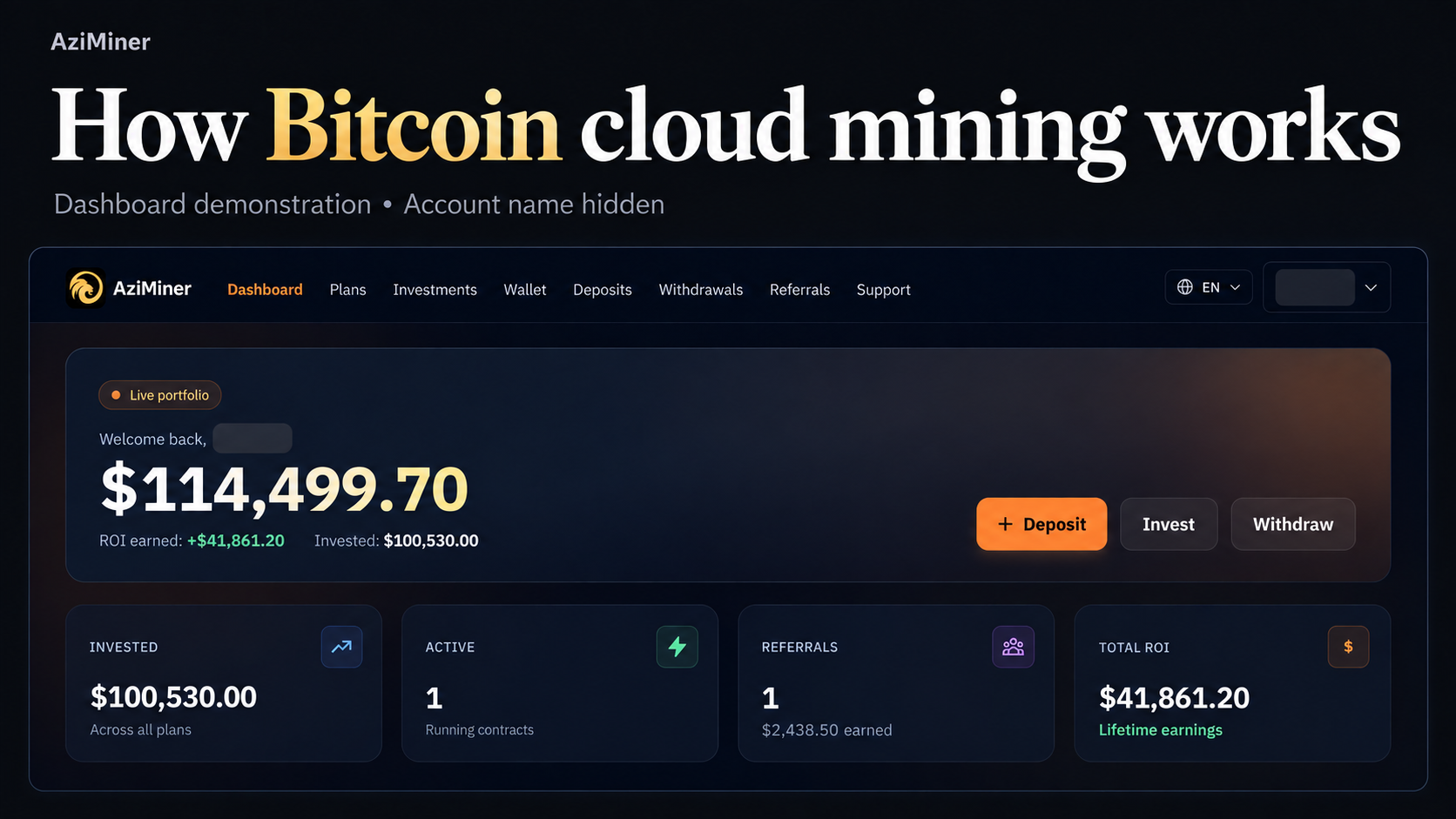
Bitcoin cloud mining lets you participate in mining through a provider that operates the equipment. You choose a contract, and the provider handles the machines, electricity, cooling and maintenance. What you receive depends on that contract’s terms.
The appeal is practical: you can access mining without finding somewhere to put a machine or learning how to keep it running.
But what are those machines doing? And how does their work connect to the balance you see in your account?
What happens inside a Bitcoin mining machine?
Bitcoin transactions are grouped into blocks. Mining machines compete to produce a valid result that allows a new block to join Bitcoin’s shared transaction record, known as the blockchain.
These machines make repeated calculations at high speed. Their computing speed is called hashrate. When a miner successfully produces a block that the network accepts, the reward includes newly issued bitcoin and transaction fees.
Many miners combine their computing power through a mining pool, which distributes payments according to its rules and the work contributed. Bitcoin’s mining documentation explains this process.
The equipment doing that work is physical. “Cloud” describes how you access the service remotely.
What do you actually buy?
With a cloud mining contract, you pay for the participation described in the agreement. Some contracts specify an amount of hashrate for a set period. Others present a plan with its own duration and payment structure.
Read that description carefully. A contract does not automatically give you ownership of a mining machine, shares in the provider or bitcoin held in your own wallet.
Buying bitcoin directly is a different transaction: you purchase an amount of BTC at the available price. With cloud mining, you enter an agreement whose outcome depends on its terms and the provider’s ability to fulfil them.
Before choosing a plan, you should be able to explain what your payment buys in one sentence.
How the process works on AziMiner
AziMiner’s published model lets customers choose a mining plan while the company manages the hardware and operations. Its website describes daily account credits and dashboard tracking, with the original payment returned at the end of paid contracts under the applicable terms. These are the platform’s stated terms, rather than an independent assessment of performance. Read how AziMiner works.
The customer journey has four parts.
1. Choose a plan
Start with the amount and duration. Then read how earnings are calculated, what charges apply and what happens to your original payment when the contract ends.
Pay attention to the difference between profit and total received. If a total includes your original payment, that portion is money being returned to you, rather than additional earnings.
Also check whether an earnings figure is an estimate or a contractual payment. Those descriptions carry different meanings.
2. Activate it
Review the selected plan and payment details before confirming. Once activation is complete, your account should show the contract’s status and its start and end dates.
Keep the confirmation. It gives you a record to compare with later account activity.
3. Track your account
Use the dashboard to follow the contract and the credits added to your balance.
An account credit records what the platform has allocated to you. It does not, by itself, show that funds have reached an external wallet. That happens through a separate withdrawal.
4. Request a withdrawal
Check the available balance, supported asset and network, minimum amount, fees and processing time.
The payment currency matters. A service can involve Bitcoin mining without settling customer withdrawals in BTC. Read the plan and withdrawal terms to find out what you will actually receive.
For a blockchain withdrawal, compare the completed transaction with the receiving wallet, including its address, amount and confirmation status.
Why the earnings figure needs context
Mining has running costs. Electricity powers the equipment, cooling removes heat, and machines need maintenance. Network competition and Bitcoin’s price can also affect the economics.
Cloud mining puts the operation in someone else’s hands, so the provider becomes part of the risk. Equipment may be running while the company still has financial or withdrawal problems.
AziMiner’s risk disclosure states that returns can be uncertain or delayed and that participants may lose some or all of their funds. A displayed earnings figure should therefore be read alongside the contract and its risks.
Where solar power and AI fit
Power management affects the cost of operating mining equipment.
In a system combining solar generation, batteries and grid electricity, solar panels provide power when sunlight is available. Batteries store energy for later use, while grid supply can cover a shortfall. The contribution of each source depends on the installation and operating conditions.
AziMiner describes using AI to monitor energy use, hardware performance and operating conditions.
The useful role of that software is managing the equipment: watching temperatures, identifying changes and helping adjust settings. It does not decide which miner wins Bitcoin’s next block, and its presence alone does not establish profitability.
What can you check for yourself?
Look for evidence that answers a specific question.
A blockchain explorer lets you inspect transfers involving a public address. Connecting those transfers to a particular company or mining operation takes additional evidence. A wallet address alone cannot establish where its funds came from or whether customer contracts are profitable.
Likewise, a screenshot of an account balance shows what an interface displays. A completed withdrawal provides a different piece of evidence.
Useful checks include clear contract terms, operational records that can be attributed to the provider, and transaction records you can examine independently.
Start with a plan you understand
Cloud mining removes the need to buy and maintain equipment yourself. Your part is to understand the agreement: what you pay, what you receive, how long it lasts and how withdrawals work.
Before activating anything, make sure those answers are clear enough that you could explain them to someone else.